Category: Electric Vehicles and Battery Technology

  • Join Our Webinar on Fire Protection Materials for EV Batteries

    Join Our Webinar on Fire Protection Materials for EV Batteries

    Webinar: Fire Protection Materials: A Key Defence Against EV Thermal Runaway

    Presenter: Dr Shababa Selim, Senior Technology Analyst, IDTechEx

    Date: Thursday October 1, 2026


    With more electric vehicles (EVs) on the road, their safety becomes an increasingly important topic. EV technology and battery design are also evolving rapidly, and this has posed a challenge to not just the vehicle OEMs but also regulators trying to impose effective safety standards. A key method of enabling EV battery fire safety is the adoption of passive fire protection materials.

    Given the variety of battery designs, there is a large selection of material solutions in use and proposed for providing fire protection and thermal runaway propagation prevention. As the market evolves and regulations become more stringent, this will enforce greater adoption of existing and new fire protective materials within the EV battery.

    · An overview of thermal runaway in EVs and regulatory landscape

    · Cell formats and cell-to-pack battery structure

    · Options and examples for fire protection materials in EV batteries

    · Insights on trends and market share predictions based on IDTechEx forecasts

    Choose your preferred time zone – the webinar runs three times during the day.

    Can’t attend live? Register anyway to receive the on-demand recording and presentation slides, available for a limited time.

  • Chemistries, Trade-Offs, and Global Lithium-Ion Batteries

    Chemistries, Trade-Offs, and Global Lithium-Ion Batteries

    The growth of lithium-ion batteries is happening largely in response to an increase in demand for applications such as electric vehicles and stationary energy storage, in line with global decarbonization goals. IDTechEx’s portfolio of Batteries & Energy Storage Research Reports and Subscriptions, covers multiple battery and energy storage options, including the latest developments across the Li-ion market.

    Li-ion chemistries

    In Li-ion batteries, anode, cathode, and electrolyte types play a key role of determining electrochemical properties and come in a variety of forms. Li-ion cells with graphite anodes are currently the dominant design, while silicon anode cells are expected to take more market share over the next ten years in premium applications. Lithium metal batteries can offer a much higher potential energy density associated with solid-state chemistries, with lithium-sulphur also proving to have very high energy density. However, maintaining a competitive cycle life will be a challenge for these chemistries. IDTechEx’s report, “Li-ion Battery Market 2026-2036: Technologies, Players, Applications, Outlooks and Forecasts“, covers these battery types in greater detail, covering advantages and disadvantages of each.

    Li-ion batteries are known to use insertion anodes and cathodes, in which lithium ions shuttle between electrodes during charging and discharging processes. This battery chemistry in particular is favored for cycle life, voltage, and competitive specific energy and operational temperature, when compared with other ion types and batteries. Sodium-ion batteries are also a well-known option for many applications covered in IDTechEx’s research. However, these face their own challenges including prevented diffusion or high charge density causing large electrostatic interactions between ions and host electrodes which can bring on rapid degradation.

    Performance qualities of Li-ion batteries

    Three key performance metrics most battery manufacturers are concerned with are high energy, fast charging, and long life, however there will always be a trade-off necessary. Fast charging and high energy will both lead to quicker degradation, with fast charging deteriorating active materials quicker and reducing energy density. Materials such as lithium metal and silicon materials, on the other hand, can improve energy density but reduce a battery’s cycle life. IDTechEx identifies this trade-off result as ‘the battery trilemma’. Developments across these fields will require much R&D by battery manufacturers and therefore come at a large cost likely to only be afforded by big companies that have the resources available.

    EV sales and global regulations

    Electric vehicles is one of the largest applications for Li-ion batteries worldwide, explored in IDTechEx’s report, “Li-ion Batteries and Battery Management Systems for Electric Vehicles 2026-2036: Technologies, Forecasts, and Players“, with China currently being the global leader in EV sales. With purchase subsidies and tax incentives now being extended to 2027, this is likely to remain the case for some time. However, regional policies across the world will play a huge role in determining electric vehicle sales.

    In Europe, tax incentives vary by country, with overarching regulation targeting carbon emissions penalties rather than incentives. In terms of decarbonization goals, there has been a focus on emissions targets for vehicle fleets in Europe, to achieve a 90% carbon dioxide reduction from tailpipe emissions by 2035, down from a previous aim of a 100% reduction. Other countries outlined in IDTechEx’s report have their own incentives for increasing Li-ion production for EVs.

    In 2024, approximately 75% of Li-ion production capacity was happening in China, with this figure expected to drop to 55% by 2031. However, fast construction times, existing supply chains and capabilities for quick investments in China may see this figure not falling as far as predicted, despite efforts from Europe and North America to catch up.

  • The Versatility of Hydrogen and Energy Transitions

    The Versatility of Hydrogen and Energy Transitions

    Hydrogen is described by IDTechEx as ‘a key enabler of energy transition’ in the latest webinar on green hydrogen. IDTechEx’s portfolio of Hydrogen Research Reports and Subscriptions covers the latest research on the hydrogen sector, as well as the key technologies working behind the scenes.

    Hydrogen’s applications

    The versatility of hydrogen across many sectors keeps it in high demand, with current applications include refining, ammonia and methanol production, and steelmaking, with some emerging applications including transportation, energy storage, gas blending, and clean synthetic fuel production.

    Decarbonizing hard to abate sectors is one of the main goals for hydrogen, specifically in fuel, heat, and industrial feedstock applications, where production has historically been associated with large carbon footprints due to fossil fuel use and high temperature processes. Green hydrogen is produced through water electrolysis, which is powered by renewable energy, with oxygen as the only byproduct. This enables applications using green hydrogen to achieve lower carbon footprints compared to those relying on hydrogen produced from fossil fuels. IDTechEx’s report, “Green Hydrogen Production & Electrolyzer Market 2027-2037: Technologies, Players, Forecasts“, covers this in greater detail.

    The colours of hydrogen

    In the transition from traditional grey hydrogen, produced through natural gas reforming, towards the longer-term goal of widespread green hydrogen, blue and turquoise hydrogen provide a transition solution. Blue hydrogen uses the same natural gas reforming processes as grey hydrogen, but incorporates carbon capture, utilization and storage (CCUS) technologies to reduce CO2 emissions. On the other hand, turquoise hydrogen is produced through methane pyrolysis which generates solid carbon instead of gaseous CO2. Both offer lower-carbon alternatives to conventional grey hydrogen.

    China leads global hydrogen production, followed by North America, the Middle East, India, and Europe, with most hydrogen production today still being very carbon intensive. Less than 1% of hydrogen production currently uses electrolysis, with low carbon hydrogen (blue and green), only accounting for 1% of hydrogen production altogether.

    Electrolyzer technologies at a glance

    A green hydrogen plant is made up of multiple components, with the electrolyzer being the core where water is split into hydrogen and oxygen. Other supporting systems, referred to as balance of plant (BOP), include heat management, water treatment, gas-liquid separation, gas purification, power conditioning, and compression or storage systems. A renewable energy site is also part of the system, providing the energy for the process.

    The four main electrolyzer technologies are largely categorized into low and high temperature technologies, with each one requiring different conditions for their operation. These include alkaline (AEL), anion exchange membrane (AEMEL), proton exchange membrane (PEMEL), and solid-oxide (SOEC) electrolyzer.

    The AEL is described by IDTechEx as being the most adopted and mature technology. Following this, the PEMEL is the second most adopted, using acidic chemistry and having start-up time benefits. The high-temperature SOEC uses solid-state chemistry and operates differently from other electrolyzer technologies and can achieve very high efficiency through integration with industrial waste heat. However, the newest electrolyzer technology on the market is the AEMEL, which can be described as a hybrid between the AEL and PEMEL. AEMELs can use low-cost materials like AELs, offer flexible loading like PEMELs, and can integrate well with renewable energy. These advantages could make AEMELs an attractive electrolyzer option, although the technology maturity has yet to catch up with AELs and PEMELs. IDTechEx’s report, “Materials for Green Hydrogen Production 2026-2036: Technologies, Players, Forecasts“, covers the makeup of the four main electrolyzer stacks, and goes into further detail on the key developments in the stack components of each technology.

  • What’s Happening with Hydrogen Across Major Sectors

    What’s Happening with Hydrogen Across Major Sectors

    Hydrogen is one natural gas that is proving to be a great source of renewable energy as far as decarbonization goals are concerned. Fuel cell vehicles, stationary fuel cells, and green hydrogen production are amongst the areas covered in IDTechEx’s portfolio of Hydrogen Research Reports and Subscriptions, that each can contribute towards increasing sustainability across major sectors including automotives and energy storage.

    Cars running on hydrogen

    Reducing transport emissions globally is a shared goal across many OEMs, to not only bring about environmental benefits but also improve air quality in particularly built-up areas, and fuel-cell electric vehicles (FCEVs) have been researched by IDTechEx as one solution. While Li-ion batteries in electric vehicles can be known to limit range to some extent, fuel cell technologies can boast greater energy density and allow for improved range and faster recharging times.

    IDTechEx’s report, “Fuel Cell Electric Vehicles 2025-2045: Markets, Technologies, Forecasts“, identifies that one of the main drivers for FCEVs was a lack of infrastructure for battery electric vehicles. However, since this issue is slowly being resolved with more charging ports available and the introduction of faster chargers, FCEV technologies might be better targeted to heavy-duty vehicles that complete long-distance journeys, rather than cars doing shorter distances. These vehicles in particular would otherwise require much larger batteries than cars and frequent charging breaks during long operating hours, which is where the energy density advantages offered by fuel cells could help.

    Stationary fuel cell technologies

    The benefits of fuel cell technologies are not limited to vehicles, as the energy storage sector is also seeing increased uptake of stationary fuel cells as a means to help reduce reliance on the grid. Solid oxide fuel cells (SOFCs), phosphoric acid fuel cells (PAFCs), alkaline fuel cells (AFCs), and molten carbonate fuel cells (MCFCs) are some examples of stationary fuel cell types covered in IDTechEx’s report, “Stationary Fuel Cell Markets 2025-2035: Technologies, Players & Forecasts“, that each have their own benefits and drawbacks.

    SOFCs are a popular option for stationary applications that require continuous power as they offer high power output, fuel flexibility, and efficient CHP operation. This type of fuel cell internally reforms fuels such as natural gas to produce hydrogen for the reaction and is one of the most mature technologies, held in higher regard than some other options. SOFCs can be costly and have long start up times, though with operating times up to 60,000 hours, this is still likely to be considered a worthwhile option to invest in.

    Green hydrogen and electrolysis

    Produced via electrolysis, green hydrogen is known to be the most sustainable type of hydrogen as its production doesn’t generate harmful emissions. With electrolysis using only water and electricity to split water into hydrogen and oxygen, the carbon footprint is minimal. However, the cost of electrolysis technologies is one barrier to wide scale deployment. The four main water electrolyzer technologies described in IDTechEx’s report, “Green Hydrogen Production & Electrolyzer Market 2027-2037: Technologies, Players, Forecasts“, are alkaline (AWE), anion exchange membrane (AEMEL), proton exchange membrane (PEMEL), and solid-oxide (SOEC), with the systems all doing the same task, but using different chemistries and operating conditions.

    The report outlines some of the main drivers for low-carbon hydrogen, including stricter regulations and carbon pricing mechanisms that penalize companies for high CO2 emissions. There are also incentives for companies to opt for low-carbon hydrogen such as government tax credits and grants, as well as international alliances, highlighting globally recognised decarbonization efforts. Private sector investments and potential export opportunities will also act as commercial drivers, and increased efficiency and reduced costs of low-carbon hydrogen technologies will also play a part.

  • Fire Protection Materials for EV Batteries to Exceed US$10B by 2037

    Fire Protection Materials for EV Batteries to Exceed US$10B by 2037

    Thermal runaway and system safety are critical topics when it comes to using lithium ion (Li-ion) batteries in electric vehicles. A key focus for the EV industry is the need to apply fire protection materials to prevent or delay thermal runaway propagating between cells and eventually outside of the battery pack. With growing regulatory momentum and safety standards, this article from IDTechEx looks at the outlook for fire protection materials market.


    Thermal runaway and system safety are critical topics when it comes to using lithium-ion (Li-ion) batteries in electric vehicles. While there are various methods for reducing the likelihood of thermal runaway, such as effective thermal management and active cooling solutions, quality control, and battery management systems, no method is 100% effective. Fire protection materials play a major role, serving as a passive method to prevent or mitigate the propagation of thermal runaway. Within the EV batteries market, IDTechEx forecasts that fire protection materials will grow at a CAGR of 13% over the next decade to exceed US$10 billion by 2037.

    Thermal Runaway and Fire Safety Standards

    There are several causes of thermal runaway, including overcharging, overheating, internal short circuits, and mechanical damage. For example, a manufacturing defect in any type of cell could cause an internal short circuit, that may lead to thermal runaway. Additionally, higher energy density cells generally exhibit higher temperatures during thermal runaway.

    With EVs becoming an increasingly large part of the fleet, their safety becomes ever more important. Although EV fires are statistically less common than fires involving internal combustion engines vehicles, safety cannot be overlooked at any rate of occurrence. As such, regulators are increasingly introducing stricter fire safety requirements for electric vehicles.

    For example, China was an early adopter of thermal runaway specific regulations, with a need to prevent fire or smoke exiting the battery pack for 5 minutes after the event occurs, among other requirements. China’s GB 38031-2025 mandated from July 2026 pushed forward with even stricter requirements for no fire or explosion under test conditions (i.e. 2 hours). Elsewhere, Europe and US mainly look to UC ECE regulations, though US’s FMVSS 305a has taken a less stringent standard for safety.

    Nonetheless, China’s GB 38031-2025 signals that the 5-minute escape time is unlikely to be sufficient for future regulations and more effective thermal runaway propagation measures will be necessary. Speaking to players, IDTechEx understands that several OEMs have started to target longer escape times in order to pre-empt future regulations and improve overall safety.

    Snapshot of Fire Protection Materials Market for EV Batteries

    A key focus for the EV industry is the need to apply fire protection materials to prevent or delay thermal runaway propagating between cells and eventually outside of the battery pack. These materials can be applied at the cell-level and at the pack-level. Materials applied at the cell-level are applied between or around the cells to help prevent propagation of thermal runaway from a specific cell. These typically include encapsulating foams, aerogels, compression pads (with additives), mica, and a few others.

    On the other hand, pack-level protection concerns materials that are used within the pack or as a coating of the pack but not directly between cells. These are generally designed to stop fire propagating between modules or outside of the pack. Typical materials in this application would be ceramic blankets (plus other non-wovens), aerogels, mica, powder coatings, intumescent coatings, and others.

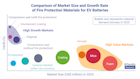
    Comparison of market size of fire protection materials in 2025 and projected growth over the next decade. Source: IDTechEx

    IDTechEx’s report on “Fire Protection Materials for EV 2027-2037: Markets, Trends, and Forecasts” looks at the different fire protection materials used at the cell-level and pack-level across vehicle types (cars, trucks, 2 and 3 wheelers, microcars, etc.). According to IDTechEx research, at present, materials with large market sizes include the likes of aerogels, mica, foam, together amassing a market revenue of over US$1.6 billion in 2025. On the other hand, although intumescent coatings, compression pads (with fire protection) and polymers captured a smaller share of the market size in 2025, IDTechEx forecasts strong growth for these materials over the next decade. 10-year market forecasts for market size and demand for materials at the cell- and pack-levels are available within the report.

    Outlook

    With evolving regulations, IDTechEx’s market forecasts show a greater adoption of fire protection materials. However, this must be paired with trends around battery development that can often reduce material use per vehicle. The variety of battery designs and material solutions presents a large opportunity across several markets and suppliers.

    IDTechEx’s report on Fire Protection Materials for Electric Vehicle Batteries analyzes trends in battery design, safety regulations, and how these will impact fire protection materials, with detailed benchmarks of fire protection materials. Using IDTechEx’s material database of over 150 materials from 72 suppliers, the materials covered include ceramic blankets/sheets (and other non-wovens), mica, aerogels, coatings (intumescent and other), encapsulants, encapsulating foams, compression pads, phase change materials, polymers, and several other materials. Each of these have more or less suitable applications, and the major categories are benchmarked in the report in terms of thermal conductivity, density, cost, and cost in the required application volume. 10-year market forecasts are included by material and vehicle category.

    For more information on this report, including downloadable sample pages, please visit www.IDTechEx.com/FPM, or for the full portfolio of research related to thermal management, advanced materials, batteries and EVs available from IDTechEx, see www.IDTechEx.com.


  • Cooling Down from High Power Demand with Thermal Management

    Cooling Down from High Power Demand with Thermal Management

    Thermal management strategies are the underdogs of modern technologies, reducing the risks of overheating in cases where exponentially increasing demand for power can lead to component temperatures rising. IDTechEx’s portfolio of Thermal Management Research Reports and Subscriptions explores thermal management developments across major sectors including data centers and electric vehicles.

    Keeping data centers cool

    Data centers are now significant contributors to power demand globally, with demand expected to keep rising in line with increasing high-performance computing, large language models, and AI use. In 2025, the total power for data centers stood at around 80GW, with this figure expected to surpass 250GW by 2035. The growth of hyperscalers such as Microsoft and AWS are expected to drive this rapid increase of power demand, alongside the increasing thermal design powers of GPUs and CPUs and overall computing capacities.

    IDTechEx’s report, “Thermal Management for Data Centers 2026-2036: Technologies, Markets, and Opportunities“, identifies multiple cooling approaches for data centers, categorized by air cooling, liquid cooling, and immersion cooling. Active air cooling can be done with a rear door heat exchanger, which takes heat carried away from the heat source using the convection of cold air, while liquid cooling takes a more immediate and direct approach. Direct-to-chip cooling or cold plate cooling is one liquid cooling method and can either be done in single-phase or two-phase. Immersion cooling, which sees an entire server placed within a tank of liquid for immediate effect, can also be done in single-phase or two-phase.

    Fire protection for electric vehicle batteries

    Electric vehicle batteries, despite being one of the main contributors to reduced reliance on fossil fuels within the transportation sector, have been known to cause fires as a result of thermal runaway. The electric vehicle industry as a whole sees multiple battery chemistries used, depending on vehicle type and requirements for size, energy density, and charge times, though Li-ion batteries are widely discussed within IDTechEx’s report, “Fire Protection Materials for EV Batteries 2027-2037: Markets, Trends, and Forecasts“, as being the dominant type.

    Opting for solid-state electrolyte in the place of more flammable liquid electrolyte is one approach to reducing fire hazards and improving a battery’s thermal stability. Solid-state batteries have a wider operation temperature range and can lead to less heat generation in the event of external heating failure, according to IDTechEx. Alongside this, their heat dissipation is notably better than with liquid electrolyte batteries, meaning hot spots are less likely to form. There are still dangers of using solid-state electrolyte batteries, such as harmful gases that can be created though reactions with moisture, though they still provide improved overall safety. However, solid state batteries are a less mature technology and do not have the same market capacity as Li-ion batteries.

    Na-ion batteries are also explored within IDTechEx’s report as being a safer alternative to Li-ion. They are able to be stored at 0V without performance impact, and at 0% state of charge, heat generation is lower. Additionally, Na-ion batteries would see thermal runaway at higher temperatures than in Li-ion batteries, as well as a slower impact.

    Fire protection in the form of regulations is also covered by IDTechEx, as the report provides research on different regions worldwide. In Europe, a 5-minute warning is required to make passengers aware of a thermal event that has started before it is visible outside the batter pack, while in China, the requirement is that the battery should not catch fire or explode for 2 hours after thermal runaway, highlighting a more advanced approach to safety.

  • The Shapeshifting Automotive Market – EVs and Autonomy

    The Shapeshifting Automotive Market – EVs and Autonomy

    The landscape of transportation looks vastly different today than it did two decades ago. The introduction of electric vehicles and autonomous vehicles is not only having positive environmental impacts as combustion engines gradually fade out, but passenger safety has never been such a high priority. IDTechEx’s portfolios of Electric Vehicles Research Reports and Subscriptions and Robotics & Autonomy Research Reports and Subscriptions cover the realms of recent vehicle advancements.

    The diversity of the EV landscape

    Electric vehicles encompass multiple types of cars powered by electricity instead of traditional combustion engines which contribute towards harmful emissions. The fleet may include the classic battery-electric vehicle (BEV), plug-in hybrid electric vehicle (PHEV), fuel cell electric vehicle (FCEV) and more. These can also be categorized into plug-in and non-plug-in, with FCEVs, for example, running on hydrogen in a fuel cell which creates electricity.

    In the passenger car market, IDTechEx’s report, “Electric Vehicles: Land, Sea, and Air 2025-2045“, predicts 70 million sales in 2045, compared with 14.4 million in 2023, highlighting strong growth to come within the biggest segment of electric vehicles. Light commercial vehicles are expected to see 11 million sales in 2045, and trucks 1.7 million, also contributing to the demand for electric vehicles across multiple sectors, including logistics and deliveries, where many companies may choose to opt for electric vehicles as a way to minimize carbon emissions and footprints. Construction vehicles becoming electrified is another trend expected to see increased uptake, for quieter and emission-free building sites.

    However, it isn’t just large vehicles becoming electric. Micro EVs are expected to see 66 million sales in 2045, following closely behind passenger cars, and will see the most uptake in regions such as Asia where they are common forms of transportation for getting around busy cities and built-up areas. The electrification of two and three-wheeler vehicles is also a more feasible and cheaper option, with smaller battery demands and less materials required overall. Micro vehicles also have many other benefits alongside affordability, including compact designs, light weight, low energy consumption, simple operation, and ease of parking. IDTechEx’s report, “Micro EVs 2026-2046: Electric Two-Wheelers, Three-Wheelers, and Microcars“, covers the developments and forecasts within this particular market, highlighting current trends across battery chemistries that are particularly sought-after for these applications.

    Multifaceted autonomy

    In parallel to electric vehicle technology advancing, autonomous vehicles are another trend that is sweeping the automotive industry. From in-cabin systems to external radar, cars manufactured today have many safety features included that make part of the advanced driver assistance system (ADAS). In-cabin sensing is one phenomenon which encompasses a multitude of technologies such as capacitive sensors for hands-on detection, ECG sensors in the steering wheel to monitor the driver’s heart rate, infrared cameras for gaze and head motion tracking, and radars for features such as gesture control and occupancy detection. IDTechEx’s report, “In-Cabin Sensing 2025-2035: Technologies, Opportunities, and Markets“, explores how in-cabin sensing systems can be split into the driver monitoring system (DMS) and the occupant monitoring system (OMS), with many technologies crossing over the two, achieving maximum safety coverage.

    Distraction and drowsiness monitoring with infrared cameras can also work alongside artificial intelligence to decipher the driver’s state of attention. This can allow the car to suggest ordering a coffee from the next service station and place an order using biometric authentication. IDTechEx’s report, “Autonomous Driving Software and AI in Automotive 2026-2046: Technologies, Markets, Players“, covers the avenues through which driving experiences can become as personalized as possible, with favourite radio stations and seating preferences of individuals also being remembered upon entry to the vehicle.

    Radar technology in vehicles, some of the latest developments for which are covered in IDTechEx’s report, “Automotive Radar Market 2025-2045: Robotaxis & Autonomous Cars“, can allow for safer driving by enabling automatic features such as automatic emergency braking (AEB) and adaptive cruise control (ACC), which 71% of new cars were fitted with in 2023. IDTechEx’s research covers short-range and long-range radar systems, and the features specific to both.

    Information gathered from radar can be fed back to intelligent software systems and allow vehicles to communicate with other vehicles on the road. They can then work together to make up a real time map and build an idea of where traffic jams or incidents may be occurring. IDTechEx’s report, “Software-Defined Vehicles, Connected Cars, and AI in Cars 2026-2036: Markets, Trends, and Forecasts“, covers communications between cars and the ways autonomous software is developing to make driving safer and more streamlined.

  • Battery Storage for Data Centers and Safer with Solid State Batteries

    Battery Storage for Data Centers and Safer with Solid State Batteries

    The battery sector is rapidly growing in multiple directions, with battery storage technologies expected to be responsible for powering many major sectors including data centers and 6G power stations, and solid-state batteries gaining increasing amounts of attention for their safer chemistries. IDTechEx’s portfolio of Batteries & Energy Storage Research Reports and Subscriptions covers the latest trends and developments within the large battery market.

    The growing demand for data center power

    The battery storage market has seen increased growth in line with energy and power demand ramping up, with data centers in particular expected to become an increasing driver of power demand. Across the US, Europe, and China, data centers are likely to see developments and advancements surrounding the ways in which they are powered, with long duration battery technologies expected to be used in the future as this approach becomes more mainstream and necessary for supporting power demand. Switching to long duration technologies will also help with improving grid flexibility.

    IDTechEx’s report, “Battery Storage for Data Centers, Commercial & Industrial Applications 2026-2036: Market, Forecasts…“, identifies that although data centers, in particular hyperscalers, will be a primary driver for battery storage demand over the next few years, 5G and 6G base stations are likely to take over in the 2030s as a result of growth in China and other regions. Battery energy storage paired with EV chargers will also maintain its prevalence as more vehicles become electrified and more charging infrastructure is needed globally. Over the next decade, the demand for global commercial and industrial (C&I) lithium-ion battery energy storage systems (BESS) is expected to jump from 22GWh to 108GWh in 2036, while the commercial and industrial sector in particular will see a compound annual growth rate of 17.4% during the same period eventually reaching a value of US$21.3 billion. It is not just large players operating at grid scale that are expected to be contributing to this growth, but smaller C&I BESS manufacturers that may be able to target market shares not yet dominated by bigger companies.

    New battery chemistries are also expected to be adopted within the battery storage sector, such as redox flow batteries and Na-ion for data centers, as a result of not only demand for longer cycle life and lower degradation, but safer technologies that don’t use flammable electrolyte. Na-ion batteries in particular are named by IDTechEx as a technology which could be used for discharging at high rates, meaning applications like volatile AI compute loads could be more easily managed.

    Solid-state safety and improved performance

    Solid-state chemistries are renowned for improved safety in their move away from flammable liquid components, which as outlined in IDTechEx’s report, “Solid-State Batteries 2026-2036: Technology, Forecasts, Players“, can be hazardous in a number of ways. Conventional lithium-ion batteries commonly use flammable liquid electrolytes based on organic carbonate solvents. Several widely used linear carbonates have relatively low flash points and high volatility, increasing fire risk if the cell is damaged, overheated, or leaks. In addition, the commonly used conducting salt LiPF₆ can decompose or hydrolyze in the presence of moisture and under thermal-abuse conditions, generating corrosive and toxic HF-containing species that may degrade cell components.

    Solid-state batteries can also provide more flexibility in shape and form factor design, which isn’t possible when the right stacking of materials in a conventional Li-ion battery needs to be considered. Solid-state batteries can also either be thin film or bulk, meaning there are more options available, and more applications that can be targeted. In terms of performance, IDTechEx states that conventional electrolyte is usually compatible with low-voltage cathodes, whereas with a solid-state electrolyte, high voltage cathodes and high-capacity anodes can be used, meaning the output practical energy density can be increased.