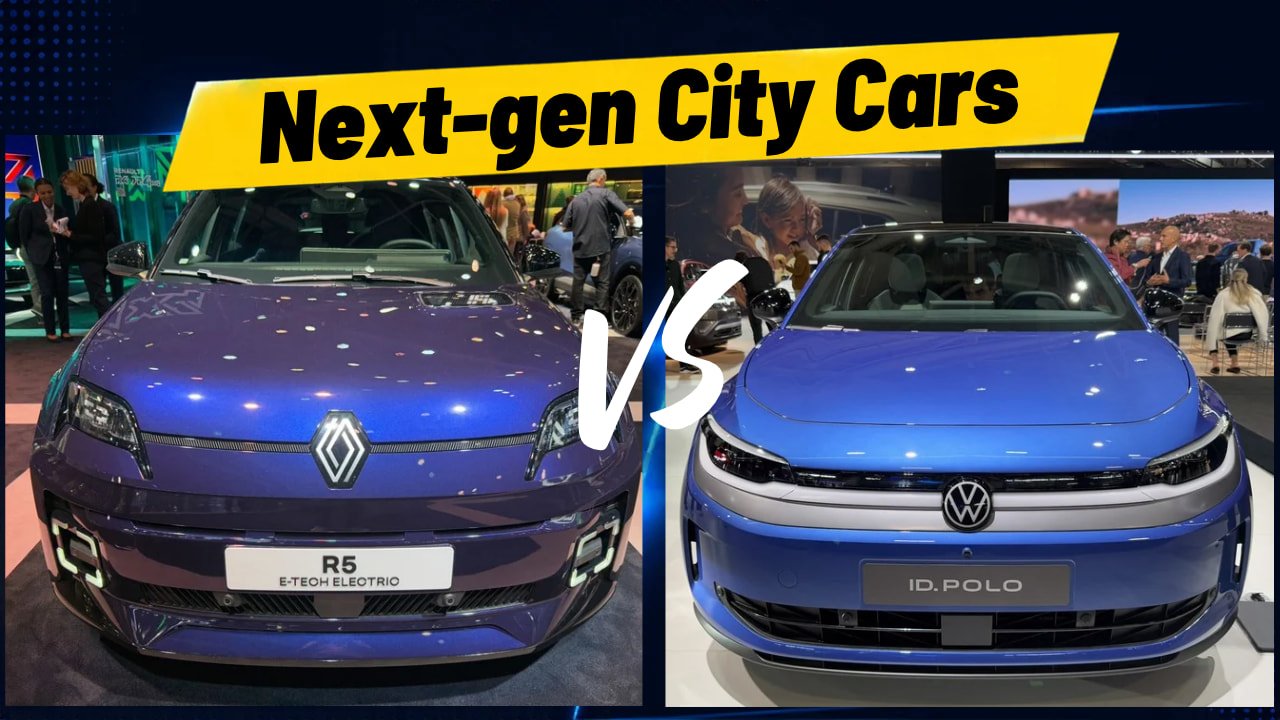
On sale in the UK since 2025, the Renault 5 E-Tech Electric now has a new rival to contend with in the VW ID. Polo. Both electric superminis carry familiar nameplates, with the Renault drawing heavily on retro styling, whereas the VW follows a more conventional hatchback design.
Renault introduced the updated 2027 model in August 2026, bringing improvements in efficiency, driving range and equipment ahead of the ID. Polo’s UK arrival. Unveiled in April 2026, Volkswagen’s electric hatchback is now available to order at UK retailers.
We got a chance to explore both Euro-spec hatchbacks at the Paris Motor Show, and having examined the design, space and features up close, here’s how the two electric superminis compare.
Design


The Renault 5 E-Tech Electric takes several styling cues from the original R5, including its compact proportions, sculpted wheel arches and rectangular headlights. The VW ID. Polo follows the brand’s new Pure Positive design language, retaining the familiar shape of a Golf or a Polo.
At the front, the Renault features rectangular LED headlights connected by a narrow black strip, a central Renault badge and square-shaped LED DRLs integrated into the lower bumper.
In contrast, the ID. Polo has a cleaner, more rounded nose. Its slim LED headlights are connected by a glass-covered horizontal strip, and available features include IQ.LIGHT LED matrix headlights, an illuminated light bar and a backlit Volkswagen badge.


From the side, the Renault looks sportier than the ID. Polo thanks to its pronounced wheel arches, black body cladding and 18-inch alloy wheels. The rear door handles are concealed beside the windows, lending it the appearance of a three-door hatchback.
The ID. Polo has a more upright roofline, short overhangs and larger side windows. Its thick C-pillar, inspired by the original Golf, prominent wheel arches and 19-inch alloy wheels give the VW a fairly broad stance. At 4,053 mm long, it is also 131 mm longer than the Renault.


At the rear, the Renault’s vertically arranged LED tail lamps take inspiration from the second-generation Renault 5 (launched in the UK as the Superfive in 1985). They extend slightly into the sides to help reduce air turbulence.
A steeply sloping rear window, black trim across the tailgate and a roof spoiler add to the retro-inspired design. The VW has a wider-looking rear, exaggerated by its horizontal LED tail lamps and large rear window extending towards the C-pillars. A roof spoiler sits above the rear window.
Interior


The Renault 5 E-Tech Electric continues its retro theme inside, featuring a layered dashboard, rectangular air vents and a three-spoke steering wheel. Its digital instrument cluster measures up to 10 inches, and a 10.1-inch central touchscreen runs the openR link infotainment system.
The latter is available with Google built-in, including Google Maps, Google Assistant and downloadable apps.
The VW ID. Polo has a simpler, more horizontal dashboard. A 10.25-inch Digital Cockpit sits behind the steering wheel, and a separate 12.9-inch Innovision touchscreen is positioned centrally.


One interesting feature is the retro display mode, which transforms the digital instruments into a layout inspired by the first-generation Golf.
Both cars retain physical controls for frequently used functions. The Renault has a row of switches below its central air vents, and the VW offers conventional steering wheel buttons, separate climate controls and a rotary controller on the centre console for adjusting the volume and changing tracks.
Heated front seats, a heated steering wheel, ambient lighting and Harman Kardon audio systems are available in both cars.


While the updated Renault 5 introduces SmartMode and cooled Qi2 wireless charging, the ID. Polo has an advantage in comfort equipment, offering 12-way electrically adjustable front seats with massage functions, driver’s seat memory and a panoramic glass roof.
Rear-seat amenities also favour the Volkswagen. The ID. Polo features two USB-C ports, a smartphone storage recess and seatback pockets. The Renault has seatback pockets and reading lights but lacks rear USB ports.
Specifications
The UK-spec Renault 5 E-Tech Electric is based on the AmpR Small platform and is available with two single-motor FWD powertrains. The UK-spec VW ID. Polo uses the newer MEB+ platform and offers three FWD powertrain options.
Renault’s entry-level powertrain produces 90 kW (121 bhp) and 225 Nm of torque. It uses a 40 kWh NMC battery, delivering a WLTP range of up to 319 km (198 miles), and accelerates from 0-100 km/h (0-62 mph) in 9 seconds.


The more powerful 110 kW (148 bhp) version develops 245 Nm and uses a 52 kWh NMC battery. Its WLTP range increases to 418 km (260 miles), and the 0-100 km/h (0-62 mph) sprint takes 7.9 seconds.
Volkswagen offers the ID. Polo with 85 kW (114 bhp) and 99 kW (133 bhp) motors, both paired with a 37 kWh (net) LFP battery. Their WLTP ranges reach approximately 322 km (200 miles) and 330 km (205 miles), respectively. Acceleration from 0-100 km/h (0-62 mph) takes 10.6 seconds in the former and 9.5 seconds in the latter.
The ID. Polo has the advantage at the top of the range. Its 155 kW (208 bhp) motor produces 290 Nm of torque and is paired with a 52 kWh (net) NMC battery.
This ID. Polo version offers up to 452 km (281 miles) of WLTP range and accelerates from 0-100 km/h (0-62 mph) in 7.1 seconds, making it 0.8 seconds quicker than the 110 kW Renault 5. Top speed is also higher at 160 km/h (99 mph), compared with 150 km/h (93 mph) in the Renault.


Both cars support 11 kW AC charging. The Renault accepts up to 80 kW DC with the smaller battery and 100 kW with the larger one, requiring approximately 31 and 30 minutes, respectively, for a 15-80% charge.
The ID. Polo supports up to 88 kW and 105 kW DC charging, taking 23 and 24 minutes, respectively, to charge from 10–80%.
The Volkswagen also wins in size and luggage capacity. It measures 4,053 mm in length, 1,816 mm in width and 1,530 mm in height, compared with the Renault’s 3,922 mm, 1,774 mm and 1,498 mm. Its wheelbase measures 2,592 mm, which is 60 mm longer than the Renault’s.


Boot capacity reaches 441 litres in the VW and up to 326 litres in the Renault, expanding to 1,243 litres and 1,106 litres, respectively, when the rear seats are folded.
Pricing & Availability
The Renault 5 E-Tech Electric has been on sale in the UK since 2025, and orders for the updated 2027 model opened in September 2026.
Current OTR prices start at £22,995 for the 40 kWh version and £27,795 for the 52 kWh version. After the UK Government’s Electric Car Grants of £1,500 and £3,750, respectively, prices start at £21,495 and £24,045.


The VW ID. Polo is available to order in the UK and is now available to view and test-drive at Volkswagen retailers nationwide. Its OTR prices range from £23,945 to £32,995 before the Electric Car Grant. Eligible versions qualify for a £1,500 discount, bringing the starting price down to £22,445.
The Renault is therefore £950 cheaper at the entry level. The difference grows to £2,785 when comparing the least expensive 52 kWh versions after the applicable grants.
However, the 52 kWh ID. Polo offers more power and a longer WLTP range, reaching 452 km (281 miles) compared with the Renault’s 418 km (260 miles), when we checked the current UK configurators.

Since 2014, I’ve worked as an international automotive editor, attending global motor shows, industry events, media drives, and tracking the latest developments across the sector, with a particular focus on electrified vehicles.