
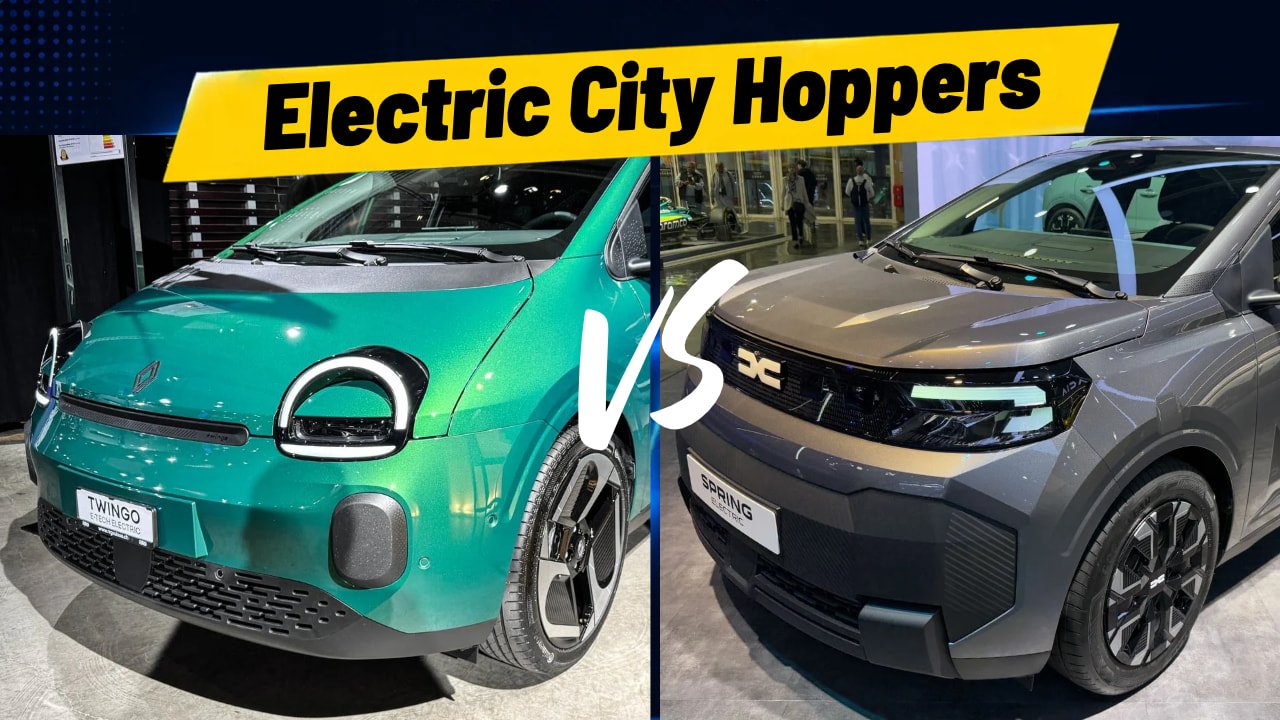
Although it isn’t immediately obvious from their appearance, the Renault Twingo E-Tech electric and 2027 Dacia Spring share almost everything in common beneath the skin, sharing Renault Group’s small electric car platform, battery and powertrain.
We got to experience both cars back to back when we traveled to the 2026 Paris Motor Show, checking out their design, interior, features, space, and other aspects.
While final UK prices have yet to be confirmed, the Twingo is targeting a UK starting price below £20,000, whereas the new Spring should be the more affordable option expected to cost less than £18,000.
With both EVs heading to the UK in early 2027, we wanted to see how these two city EVs differ in design, interior and specs, and whether the Renault offers enough to justify its expected price premium.
Design


Based on their exterior designs, you couldn’t tell that the Renault Twingo E-Tech and Dacia Spring share the same basic structure. The Twingo draws heavily on the rounded styling of the original 1992 model, whereas the Spring has a more upright, angular appearance, closer to a small SUV.
At the front, the Twingo features large, arched LED DRLs above its rounded headlights and a subtly smiling grille. The Spring, on the other hand, has a noticeably more serious look, featuring a raised, flat bonnet, slim horizontal lighting elements linked by a broad black strip, and a large protective bumper panel.


Viewed from the side, the similarities become more apparent in the shape of the windows and roofline. However, the Twingo’s smooth body panels and rounded wheel arches contrast with the Spring’s straighter surfaces, pronounced arches and black lower-body cladding.
The Dacia also has a longer rear overhang and a black strip separating the roof from the body. Renault offers wheels up to 18 inches, compared with 15- and 16-inch designs on the Spring.
At the rear, the Twingo features semicircular LED tail lights flanking an oval-shaped rear window, along with rounded bumper guards that echo the car’s front-end design.


The Spring has a more squared-off tailgate, angular tail lights connected by a black trim strip and raised shoulders above the rear wheels. Its larger protective bumper gives it a more boxy and upright appearance than the Renault.
Interior
The Renault Twingo E-Tech and Dacia Spring don’t share the same interior, although both have a simple, minimalist layout. The Twingo’s dashboard has a floating, cylindrical oval design that blends retro cues with modern digital screens.


In contrast, the Spring features a more angular dashboard, rectangular air vents and blue-green trim accents. The two models make extensive use of hard plastics.
In Euro-spec, both cars feature a 7-inch digital instrument cluster, but their infotainment equipment differs. The Twingo has a 10-inch (reported 10.1-inch by some outlets) central touchscreen supporting Apple CarPlay and Android Auto, with Google built-in available through OpenR Link.
The Spring offers Media Control with a smartphone holder, or an available 10.1-inch Media Nav Live touchscreen providing connected navigation and wireless Apple CarPlay and Android Auto.


We appreciated the simple physical controls in each cabin, particularly the three rotary dials for the climate functions.
The Twingo’s column-mounted gear selector also frees up storage space between the front seats. The Spring provides an open passenger-side dashboard shelf, several centre-console compartments and YouClip mounting points for accessories.
Each car can seat four people, but the Twingo has a clear advantage in rear-seat flexibility. Its two independent rear seats can slide by 17 cm, recline and fold separately, allowing passengers to adjust legroom and luggage capacity. The Spring has a fixed rear bench with a 50:50 split-folding backrest.


The Twingo offers 260-360 litres of boot space depending on the rear-seat position, including a 50-litre underfloor compartment for charging cables.
The Spring provides 325 litres beneath the luggage cover, increasing to 337 litres with the cover removed. A separate front storage compartment is available on the Euro-spec Spring.
Available for the Twingo in certain European markets, the optional Twingobay panoramic glass roof is set to arrive in the UK in 2027.
Specifications
The two Euro-spec cars are almost identical mechanically, using Renault Group’s small electric car architecture and have a front-mounted motor driving the front wheels.
Each produces 60 kW (80 bhp) and 175 Nm of torque, accelerates from 0-100 km/h (0–62 mph) in 12.1 seconds and has a top speed of 130 km/h (81 mph).


Both cars also use a 27.5 kWh usable lithium iron phosphate (LFP) battery, although the Twingo has a slight advantage in driving range. The Renault has a WLTP range of up to 263 km (163 miles), compared with 250 km (155 miles) for the Spring, giving it a modest advantage of 13 km (8 miles).
Charging capabilities are exactly matched. Both feature a 6.6 kW AC onboard charger, with 11 kW AC and 50 kW DC charging available through additional charging packages.
Using 50 kW DC charging, it takes approx. 30 minutes to charge the Twingo’s battery from 10-80%, whereas the Spring takes 28 minutes from 15-80%.
The Euro-spec Twingo measures 3,789 mm long, 1,720 mm wide and 1,491 mm tall. And the Euro-spec Spring measures 3,855 mm long, 1,722 mm wide and 1,519 mm tall, making it 66 mm longer, 2 mm wider and 28 mm taller, though we felt that both cabins offer the same level of headroom and shoulder room.


Each car’s width measurements exclude the mirrors. Their wheelbases are almost identical, at 2,493 mm for the Renault and 2,492 mm for the Dacia.
The two cars should also be easy to manoeuvre in tight spaces, as the Twingo has a turning circle of 9.87 metres, compared with approx. 9.9 metres for the Spring.
Pricing & Availability
The Renault Twingo E-Tech electric is expected to arrive in the UK in early 2027. The Evolution is priced at £14,745 after the £3,750 Electric Car Grant, compared to the list price of £18,495. The Techno is priced at £16,245, and the Launch Edition costs £17,645.
The 2027 Dacia Spring is due in the UK in the first half of 2027, with an expected starting price below £18,000. For reference, in France, the Twingo starts at €19,490 (approx. £16,260), compared with €17,900 (approx. £14,933) for the Spring, a difference of €1,590 (approx. £1,326).
The two models are built at Renault Group’s Novo Mesto plant in Slovenia, marking a move to European production for the Spring, whose predecessor was built in China.
With nearly identical powertrains, the Spring should appeal to budget-conscious buyers, whereas the Twingo offers more flexible rear seating, which could justify its higher price tag.

Trained as an automobile engineer, I’ve been following the global car market since 2005. Over the past 17 years, I’ve been involved in online automotive analysis and publishing, traveling the world to drive, evaluate, and experience new cars and technologies.