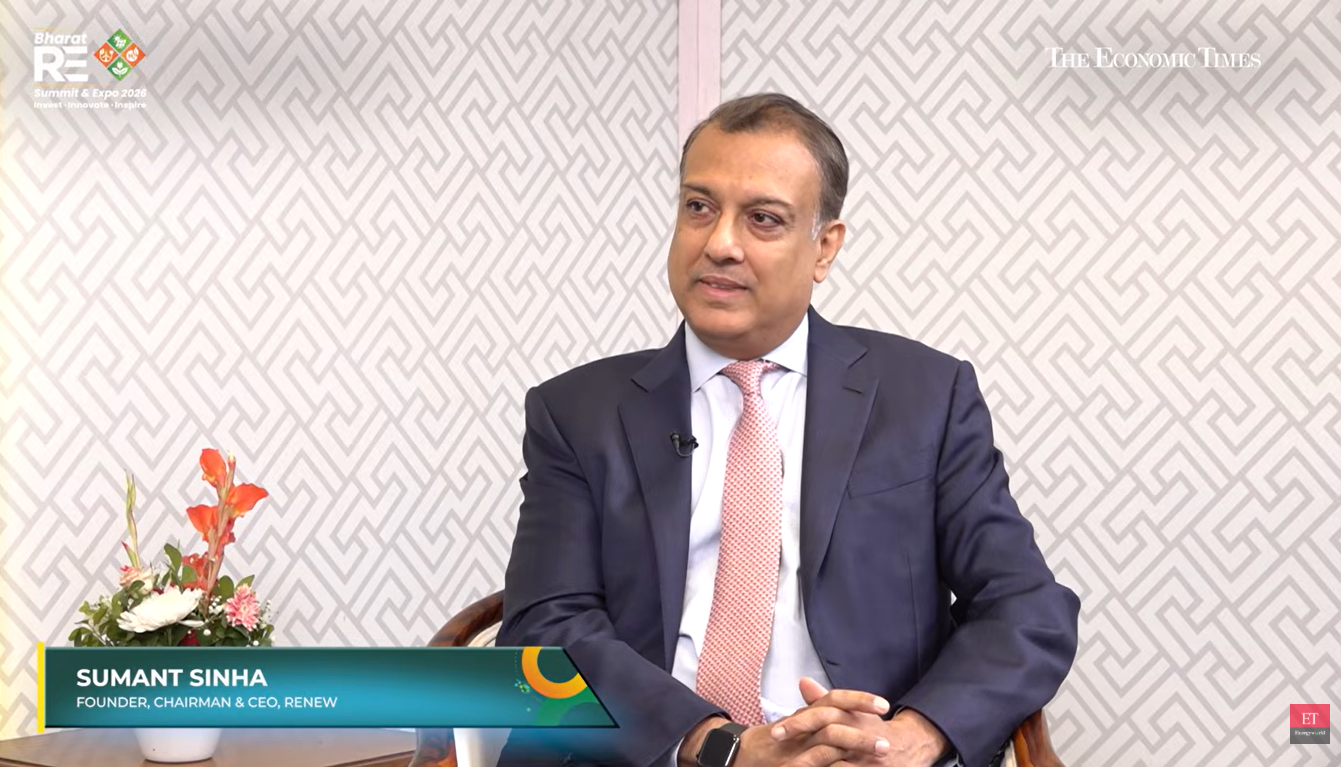
India needs to move beyond adding renewable energy generation capacity and focus on storage, transmission infrastructure and domestic manufacturing of green molecules to ensure reliable clean power delivery, said Sumant Sinha, chairman, founder and chief executive officer of ReNew, in an interview with ETEnergyWorld at the Bharat Renewable Energy Summit and Expo 2026.
He said that the growing mismatch between daytime renewable power generation and evening electricity demand is creating challenges for the grid and distorting prices in merchant power markets, making a combination of battery storage and pumped hydro essential. Edited excerpts:
There is a need to move from installed capacity to clean energy delivery. What are the top three roadblocks limiting delivery today?
You’re absolutely right. Plain vanilla generation of clean energy is no longer enough. We are facing the classic duck curve problem, where there is too much surplus power in the daytime and not enough in the evening, and that is making prices go quite wonky in the merchant markets.
What we need going forward, first, is a lot more storage in our grid. We need a lot more batteries, because they can be installed in less than a year. In the long run, we also need pumped storage, because it provides long-duration storage. So we need a mix of both batteries and pumped storage.
The second thing is that Indian energy demand is growing very dramatically, so we need to make sure the transmission build-out continues at a pace that can deliver all this clean energy into the system.
Thirdly, as a country, especially in light of energy security, we need to manufacture a lot of our green molecules domestically, so that we can decrease our dependence on imports of gas, ammonia, urea and so on, and become much more self-sufficient. That opportunity is in front of us, but we really need to move with rapid speed in that direction.
Renewables today are also a national security issue, not just a climate one. How should government policy and procurement reflect this, and what role does domestic manufacturing play?
You’re absolutely right that we can’t trade dependence on fossil fuels for dependence on one country for clean-tech equipment. We have to find ways, especially in today’s geopolitical context, where supply chains can be disrupted for any reason. It could be a pandemic, a war, or a problem with shipping routes. So we need to manufacture as much as we can within our own borders, and that means we need to develop the clean-tech supply chain in the country.
We need to make end-to-end solar modules. We need to be able to make batteries. And we need to be able to make rare-earth permanent magnets, and, of course, all the components that go into making all of these things.
Solar and wind alone are not enough to meet the growing demand. Which will scale fastest in the next two to three years: storage, pumped hydro or hybrid projects? And how is ReNew building firm, round-the-clock supply?
We are the first company to have built an around-the-clock power project in India. It was a 400 MW project that we started building in 2022 and finished last year. It took us a while. It had 1,100 MW of total wind and solar capacity along with 100 MWh of batteries. I’m proud that we pioneered that concept in India.
We need more of that to deliver firm renewable energy into the grid, and that requires a combination of wind, solar and storage. As I said earlier, storage is going to find much deeper traction in the market in the years to come.
Data centres, AI infrastructure and big industrial users are emerging as big buyers of green power. How is ReNew structuring supply for them, and what do these customers need that traditional offtakers don’t?
If you look at corporate demand in India in general, a lot of it is moving to direct sourcing through the open access or group captive market. We are now supplying almost 3 GW of power directly to end corporate customers, and we are among the largest companies in India supplying directly to customers. That market is going to continue to grow substantially, and we are very excited about it because we already have a pretty strong presence in it.
In addition to the traditional corporate market, there will be a lot of new demand coming in from data centres. We need to make a rule that data centres must procure at least a certain minimum, maybe 50 per cent to 60 per cent, of their energy from clean sources from the get-go, and that number should only increase over time. The last thing you want is for data centres to come into the country, become big consumers of electricity, and draw it from sources that are not clean, because that would aggravate the climate change and pollution problems. That should not happen. A lot of the hyperscalers are already trying to move towards clean energy, and to the extent that we can hasten that process, we must do so.
India needs to build cells, wafers and ingots, not just modules. What will decide whether India becomes a globally competitive manufacturing market?
I think we will become one. The government’s policies are encouraging us to set up manufacturing capacities in India. We have surplus capacity in modules. We have sufficient capacity coming up by next year in cells. I think two to three years from now, we will have sufficient capacity in wafers as well. There is a scheme coming out for making polysilicon. So the entire solar value chain will eventually be indigenised over the next four to five years. Once that happens, it is up to industry to get costs down even further, and given the level of competition in the industry, I’m sure that will happen.
Over time, we also need to bring R&D in-house, start making the capital equipment, and develop all the backend industries, so that our solar manufacturing becomes really competitive. I think India has a unique opportunity to become the diversification to China’s supply chain, where other countries can also buy from India and get the diversification that everybody in the world needs right now, because there is just too much concentration risk in our clean-tech supply chains at this point.
As we wrap up, what is your outlook for the clean-tech industry over the next two to three years?
I think the future is very bright for us. This is going to be one of the biggest sectors in the country. It is going to draw in a huge amount of capital investment, in the hundreds of billions of dollars every year, across manufacturing, the minerals before that, generation, transmission, battery storage, and the downstream industries on green molecules that are hopefully likely to emerge as well. And then there is circularity. There are a whole bunch of things that are going to happen in our sector, which are going to be extremely interesting.
What will be the biggest growth drivers?
First of all, India is a massive energy market, and our energy demand is growing at the fastest rate of any major country in the world. Our electricity demand grew by 11 per cent year to date, which is unprecedented. That is a very big driver in creating a bigger market. That bigger market gives scale to do so many things from a manufacturing and generation standpoint. It also excites investors, because they realise that India is such a big market with a really vibrant ecosystem.
Join the community of 2M+ industry professionals.
Subscribe to Newsletter to get latest insights & analysis in your inbox.
All about ETEnergyworld industry right on your smartphone!
- Download the ETEnergyworld App and get the Realtime updates and Save your favourite articles.