
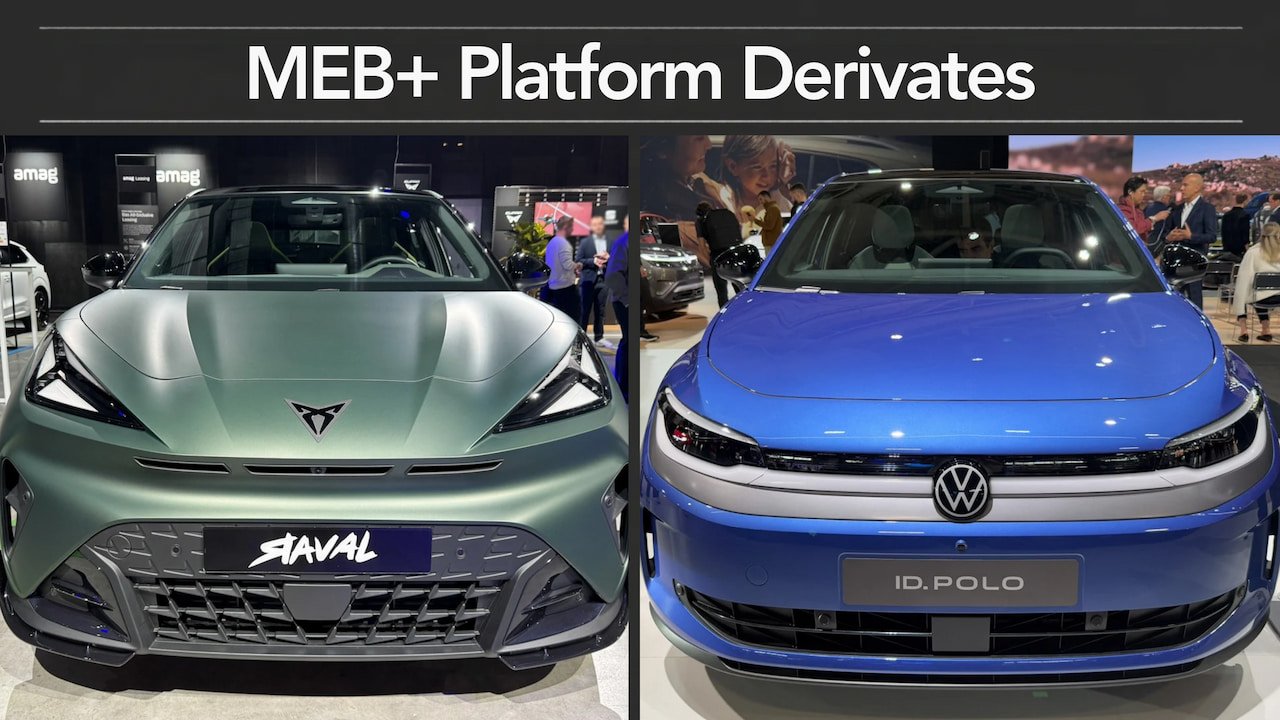
Although both roll off the same production line in Martorell, Spain, the VW ID. Polo and Cupra Raval take rather different approaches to their design and dynamics. The Volkswagen sticks to a familiar hatchback design, whereas Cupra has given the Raval sharper, sportier styling and a more driver-focused chassis setup.
Cupra unveiled the Raval in April 2026, and Volkswagen followed with the ID. Polo’s world premiere later that month. The Raval reached UK showrooms in August, followed by the ID. Polo in November.
Despite their different characters, the two cars share the Volkswagen Group’s MEB+ platform and many of the same mechanical components.
Having examined the Raval and the ID. Polo in detail, we wanted to see just how much separates these closely related electric hatchbacks.
Design


The differences between the two cars are obvious right from the front. The ID. Polo gets a simple, rounded nose, following its new Pure Positive design language. Slim LED headlights sit at either end of a glass-covered horizontal strip, and a broad body-coloured section separates them from the lower air intake.
Cupra has a more aggressive front-end design. The Raval’s sharply angled headlights cut deep into the front wings, and the available Matrix LED units feature the brand’s three-triangle light signature.
Its low, pointed nose has prominent bonnet creases, a large black lower grille and angular openings at the bumper corners. We feel the front end looks considerably sportier than the Volkswagen’s, without appearing like a modified version of the same car.


The contrast continues along the sides. The ID. Polo has an upright roofline, a relatively straight shoulder line and large side windows bordered by thick C-pillars at the rear.
The Raval has a more sloping roofline, a higher-looking shoulder and more pronounced sculpting around the wheel arches. Its dark C-pillar treatment also makes the rear side glass appear to extend towards the back window.
The Raval’s flush, electrically extending door handles are another noticeable departure from the Volkswagen’s more conventional design. Both hatchbacks offer alloy wheels measuring up to 19 inches, but Cupra’s angular wheel designs better suit its sharper bodywork. Despite their different appearances, the two cars have almost identical footprints.


At the rear, the ID. Polo retains its simple styling. A broad rear window extends towards the C-pillars, and the almost rectangular LED tail lamps feature 3D elements connected by an illuminated strip. A roof spoiler completes the look.
The Raval’s rear is considerably busier. Its full-width LED light bar features an intricate 3D pattern and an illuminated Cupra logo. A more prominent roof spoiler and a diffuser-style lower bumper add another notch to its sporty look.
Even with the Raval’s more adventurous styling, the Volkswagen’s cleaner design is likely to appeal to buyers looking for a traditional hatchback.
Interior
The differences are just as noticeable inside. Volkswagen has kept the ID. Polo’s dashboard simple and horizontal, using textile surfaces that extend into the door panels. The Cupra Raval has a more driver-focused cabin, featuring a sculpted dashboard, copper-coloured detailing and a sportier steering wheel.


Both cars feature a 12.9-inch central infotainment touchscreen and a 10.25-inch digital instrument display. Cupra uses an Android-based infotainment system with access to third-party apps, whereas the ID. Polo offers a retro display mode inspired by the original Golf.
One area where Volkswagen has an advantage is the control layout. The ID. Polo brings back physical buttons for the climate controls, conventional steering-wheel switches and a rotary dial for adjusting the audio volume or changing tracks.
Cupra also provides physical steering-wheel buttons, including controls for the driving modes, but relies more heavily on the touchscreen and touch-sensitive sliders for climate adjustments.
Both hatchbacks offer electrically adjustable front seats, a memory function for the driver’s seat, a panoramic glass roof and premium audio systems. The Volkswagen can be equipped with massage seats and a 10-speaker Harman Kardon sound system.


Cupra offers more unusual features, including 3D-knitted seat upholstery, animated ambient lighting, door-panel projections and a 12-speaker Sennheiser sound system.
The Cupra has the advantage of rear air vents, and both provide USB charging ports. Luggage capacity is identical at 441 litres, which is generous for electric hatchbacks of this size. Folding the rear seats expands the Volkswagen’s luggage capacity to 1,243 litres.
Specifications
The UK-spec VW ID. Polo and Cupra Raval share the MEB+ platform, front-wheel-drive layout and two battery options: a 37 kWh lithium iron phosphate (LFP) battery and a larger 52 kWh nickel manganese cobalt (NMC) battery. However, their powertrain line-ups differ slightly.
The ID. Polo offers three motor outputs: 85 kW (114 bhp), 99 kW (133 bhp) and 155 kW (208 bhp). The first two use the smaller battery, delivering WLTP ranges of up to 322 km (200 miles) and 330 km (205 miles), respectively.


Cupra currently offers the 37 kWh Raval with a 99 kW (133 bhp) motor and a WLTP range of 327 km (203 miles). Both 99 kW versions accelerate from 0-100 km/h (0-62 mph) in 9.5 seconds.
Moving to the 52 kWh battery, the two hatchbacks have the same 155 kW (208 bhp) output and 290 Nm of torque. They also share a 0-100 km/h (0-62 mph) time of 7.1 seconds. The Volkswagen has a small advantage in driving range, offering up to 452 km (281 miles) on the WLTP cycle compared with 443 km (275 miles) for the Cupra.
The Raval goes a step further with its higher-performance VZ version, rated at 165 kW and 290 Nm in UK-spec Cupra. It accelerates from 0-100 km/h (0-62 mph) in 6.8 seconds and has a top speed of 175 km/h (109 mph), compared with 160 km/h (99 mph) for the regular ID. Polo.


The extra performance comes at the expense of driving range, which drops to 383-385 km (238-239 miles) WLTP in the UK market.
There is little to separate the two when it comes to charging. Both Euro-spec cars support 11 kW AC charging. The 37 kWh ID. Polo accepts up to 90 kW DC, compared with 88 kW for the equivalent Raval. Both 52 kWh versions support up to 105 kW DC.
Under suitable conditions, charging from 10-80% takes approximately 23 minutes with the smaller battery or 24 minutes with the larger one.
Cupra has also given the Raval a sportier chassis setup, sitting 15 mm lower than the MEB+ platform baseline. The VZ adds Dynamic Chassis Control (DCC), an electronic limited-slip differential and Launch Control, making it the more performance-focused option of the two currently available ranges.
Volkswagen has tuned the regular ID. Polo more towards everyday ride comfort and predictable handling.
Despite their shared underpinnings, the ID. Polo is slightly larger, measuring 4,053 mm long, 1,816 mm wide and 1,530 mm tall. The Raval measures 4,046 mm, 1,784 mm and 1,514 mm, respectively. Both have a wheelbase of approximately 2,600 mm.
Pricing & Availability


The VW ID. Polo is the more affordable option in the UK, starting at £23,945 (£22,445 after the £1,500 Electric Car Grant) for the 37 kWh, 85 kW (114 bhp) version. The 99 kW (133 bhp) version is also available to order from £23,555 after the grant.
The Cupra Raval starts at £25,495 after the grant for the 37 kWh, 99 kW (133 bhp) version. With the larger 52 kWh battery and 155 kW (208 bhp) motor, the ID. Polo starts at £26,830 after the grant, undercutting the equivalent Raval by £1,665.
At the higher end, the ID. Polo Style Launch Edition is available from remaining stock at £31,495 after the grant. As of November 2026, the more powerful Raval VZ has been launched at £33,495 and the VZ Extreme at £34,810 after the grant. A cheaper Raval Origin, priced at £23,785 before any grant, is expected in 2027.
EVW says
The Raval’s sportier character is certainly worth paying extra for, but the ID. Polo makes a lot of sense as an everyday car.

Trained as an automobile engineer, I’ve been following the global car market since 2005. Over the past 17 years, I’ve been involved in online automotive analysis and publishing, traveling the world to drive, evaluate, and experience new cars and technologies.

