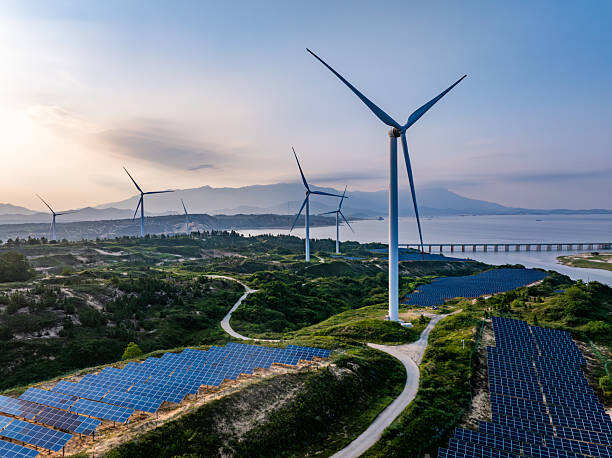
India was the world’s second-largest market for annual solar and wind capacity additions in 2025, behind China, and is expected to retain its position in the coming years, supported by rising electricity demand and falling equipment prices, according to a recent report by BloombergNEF.
The report titled, ‘India Transition Factbook’, added that India ranked fifth globally in energy-transition investment, attracting $72 billion in 2025, equivalent to about 1.7 per cent of its gross domestic product (GDP).
The country’s wind and solar sectors will require $123 billion to $163 billion in capital investment through 2030, in real 2025 dollar terms, the report said. It said non-fossil fuel technologies have accounted for 80 per cent of new power generation capacity added to India’s grid over the last decade.
India’s size, rapid economic growth and rising energy demand make it central to global efforts to shift toward lower-carbon energy sources. The country also has a major energy-security imperative to reduce its reliance on imported oil and crude products.
These dual goals of expanding clean energy and cutting fossil fuel imports are increasingly aligned and economically viable.
“These sources also supplied one-third of the country’s electricity demand in the first seven months of 2026, though coal still provided the majority of power,” the report noted.
It said that India is also on track to meet its revised target of reducing GDP emissions intensity by 47 per cent from 2005 levels by 2035.
The transition to lower-carbon energy sources could also strengthen India’s energy security by reducing its reliance on imports. Even without additional policy support, an economics-led transition could bring energy imports down from 5.3 per cent of GDP in 2025 to 3.1 per cent by 2035 and 1.5 per cent by 2050.
An economics-led shift to lower-carbon energy could reduce India’s energy imports from 5.3 per cent of GDP in 2025 to 3.1 per cent by 2035 and 1.5 per cent by 2050, even without additional policy support, BloombergNEF modelling showed.
Indian companies signed contracts to supply 0.3 million metric tonnes of clean hydrogen annually in the first four months of 2026, taking India to third place globally in cumulative contracted volumes, the report added.
Low-cost renewable power, subsidies and competitive auctions have helped Indian producers offer competitively priced green ammonia and attract overseas buyers.
India is likely to miss most of its 2030 EV adoption targets, with three-wheelers the exception. The targets include EVs accounting for 80 per cent of two- and three-wheeler sales, 70 per cent of commercial vehicle sales and 30 per cent of private car sales.
As artificial intelligence gains traction among government and private entities, India’s data-centre electricity demand could surge from 11 terawatt-hours in 2025 to 636 terawatt-hours by 2050, accounting for about 11 per cent of total power consumption, according to the Factbook.
With coal supplying around 68 per cent of India’s electricity, data centres can reduce their reliance on carbon-intensive power by procuring renewable energy through third-party contracts, captive projects, rooftop solar and power exchanges.
Join the community of 2M+ industry professionals.
Subscribe to Newsletter to get latest insights & analysis in your inbox.
All about ETEnergyworld industry right on your smartphone!
- Download the ETEnergyworld App and get the Realtime updates and Save your favourite articles.